

Written by Annemarie Samuels and David Clark
The contribution of the social sciences to the field of palliative and end of life care has been steadily growing in recent decades. With that we see emerging centres of interest: conducting research and teaching students in areas such as sociology, anthropology, psychology or health and social policy. New professional societies and journals have also emerged, along with well-established conferences, websites and networks. In turn, major funders have taken increased interest in these activities, with significant grants being awarded to end of life researchers who bring theories and methods from social science and the perspectives of the humanities to pressing issues relating to palliative and end of life care in its social context.
Around the world, these endeavours take several forms and areas of interest. Some work concentrates on the history and development of palliative care as a healthcare specialty. Many researchers focus on the lived experience of receiving and giving care in the context of life-limiting illness. Others connect this explicitly to policy framing and implementation. Some adopt a disease-specific lens, such as cancer, neurological or respiratory conditions, whilst others take a life course perspective focussed on children, young adults or older people. There is also growing interest in post-colonial analyses of end of life care and moves to decolonise palliative care. The range of concepts and definitions within and around the field provide rich territory for theoretical reflection and critique. There are also established methodological sub-fields, using narrative methods, case studies, digital story-telling, innovative ethnographic methods, and policy discourse analysis, alongside established ethnographic and quantitative methods of enquiry.
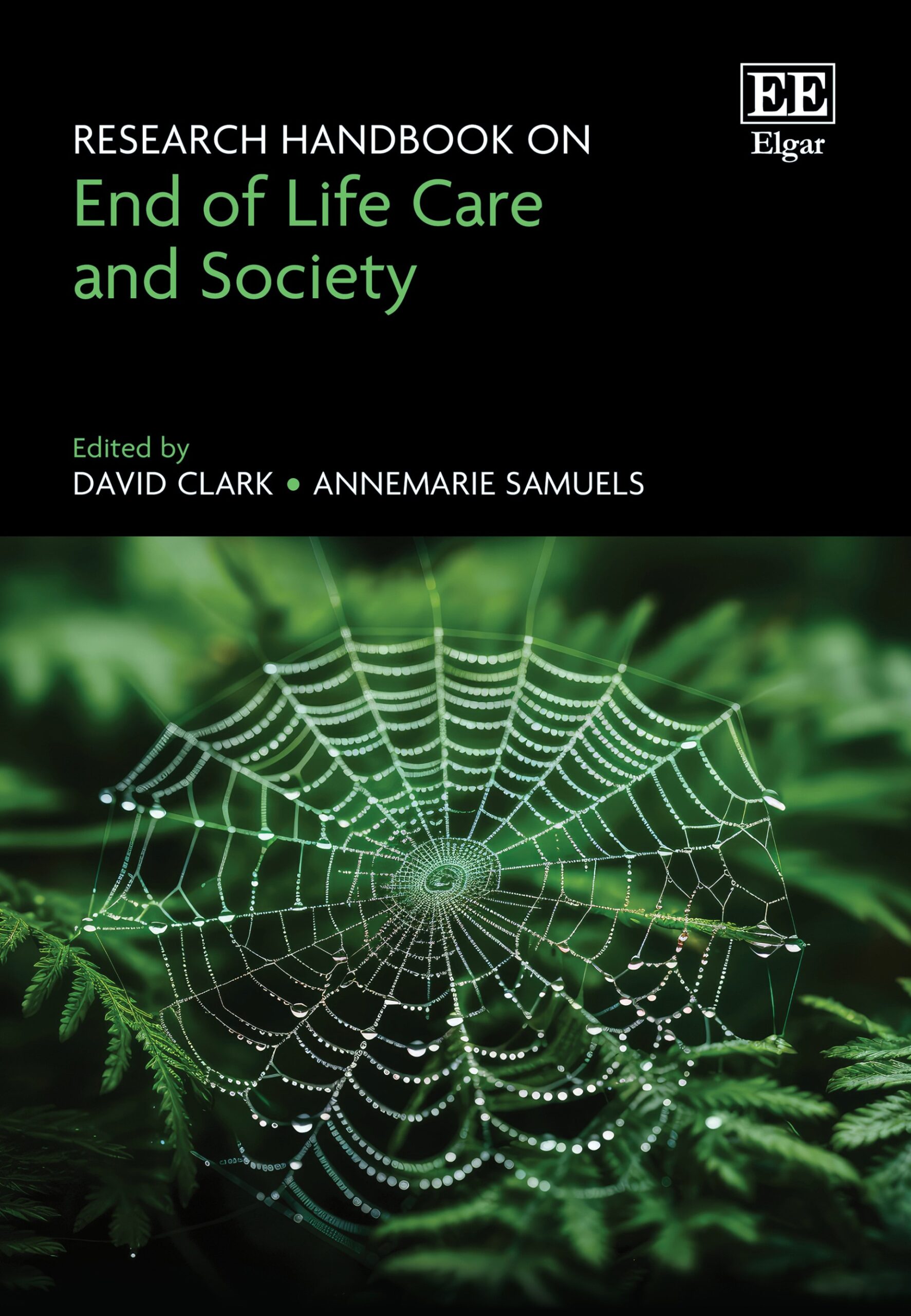
Yet to date these diverse areas of academic endeavour have perhaps lacked a major textbook bringing together this wealth of activity and opening windows on the rich territory of end of life social science. Now that has changed, and we are delighted to announce the publication of a wide-ranging collection of work to be found in our co-edited and newly published Research Handbook on End of Life Care and Society.
Some important principles sit at the heart of the book. As we make clear in our introductory chapter, in a world where around 1 million people die each week, we take the view, as editors, that there is no magic bullet, single intervention, or policy roll out that can ameliorate all the diverse forms of suffering that manifest themselves for those experiencing serious illness, disability and frailty at the end of life. Global thinking and strategy can set a context for this, but local action, embedded within specific places and cultures, remains essential to the provision of palliative and end of life care as part of Universal Health Coverage. We consider that this global challenge can only be met to the extent that we see these issues as profoundly inflected with social considerations, possibilities and constraints. The Handbook is therefore about end of life care in society. It harnesses the social sciences and humanities to a set of problems that remain dominated by medicalised and managerial solutions within health care systems, and in so doing it takes us into a vast range of perspectives on something that, as Peter Berger1 observed long ago, is essential to social life itself: the human encounter with dying, death and bereavement.
Building on insights from our own research endeavours, we therefore undertook to co-edit a work that would provide a wide-ranging, in-depth and accessible overview of research on end of life care in the societal context. In this respect the Handbook differs from most other major collections and textbooks in the field, which, with a few exceptions, are largely clinical in orientation. The Handbook highlights social science perspectives on end of life care, providing an overview of theories, methods and substantive themes. These are hugely important in a world where how and where we die are becoming increasingly challenging issues, often surrounded with contestation and debate. Population ageing, pandemics, growing pressures on health and social care systems, new cultural responses to human mortality, assisted dying, bereavement and loss, specialised fields of intervention in end of life care – all of these call out for new analyses rooted in the social sciences.
The Handbook reflects the best work of this type being undertaken by scholars and researchers around the world. It is organised into five parts, beginning with theoretical and methodological issues, before moving into a series of chapters on the diverse cultural contexts and forms of end of life care. We then explore the fields of practice associated with this work and some of the technologies, ideas and frames of reference that have been used in its development. This takes us on to the social inequalities that are found in accessing and experiencing palliative and end of life care, before concluding with a set of chapters that focus on policy evaluation, and on research that can influence policy making.
When the invitation came to edit a research Handbook for a renowned series at Edward Elgar Publishing, it didn’t take us long to accept. Three years on, our book and the work of some 60 contributors from 20 countries, is out in the world. We thank everyone involved from contributors, supporters and reviewers to the excellent team at Edward Elgar that guided us throughout. The finished product is a handsome hardback publication to grace any library bookshelf, but more importantly, and thanks to the generous support of institutional funding and also philanthropic giving, the work is now fully available on Open Access and you can find all 34 chapters here.
We are now planning two hybrid launches for the book – on 16th October (Leiden University) and 30th October (University of Glasgow, Dumfries Campus). For Leiden see these details online and we kindly ask everyone who wants to join us to register here . For the University of Glasgow book launch, details are below and via this Eventbrite link:
Date: Thursday 30th October
Time: 5.30pm
Location: Room 232, Rutherford McCowan Building, The Crichton, University of Glasgow, Dumfries, DG1 4ZL
Online Attendance: https://uofglasgow.zoom.us/j/84006224344
_______________________________________
- Berger, Peter L. The Sacred Canopy: Elements of a Sociological Theory of Religion. Garden City, NY: Doubleday, 1967. ↩︎
_________________________________________
Biographies
Annemarie Samuels is the Principal Investigator of the European Research Council-funded project Globalizing Palliative Care? A Multi-sited Ethnographic Study of Practices, Policies and Discourses of Care at the End of Life. She is an Associate Professor of Cultural Anthropology and Development Sociology at Leiden University.
David Clark is Professor Emeritus at the University of Glasgow. He has wide ranging interests in the history and global development of palliative care. His monograph on the history of palliative medicine from the nineteenth century, entitled To Comfort Always, was published by Oxford University Press in 2016. With a particular knowledge of the life and work of Dame Cicely Saunders, he has edited her letters and selected publications and his biography of her Cicely Saunders: A Life and Legacy was published to mark the centenary of her birth in 2018.