

Written by Graeme Hendry, MSc., NMP, RN
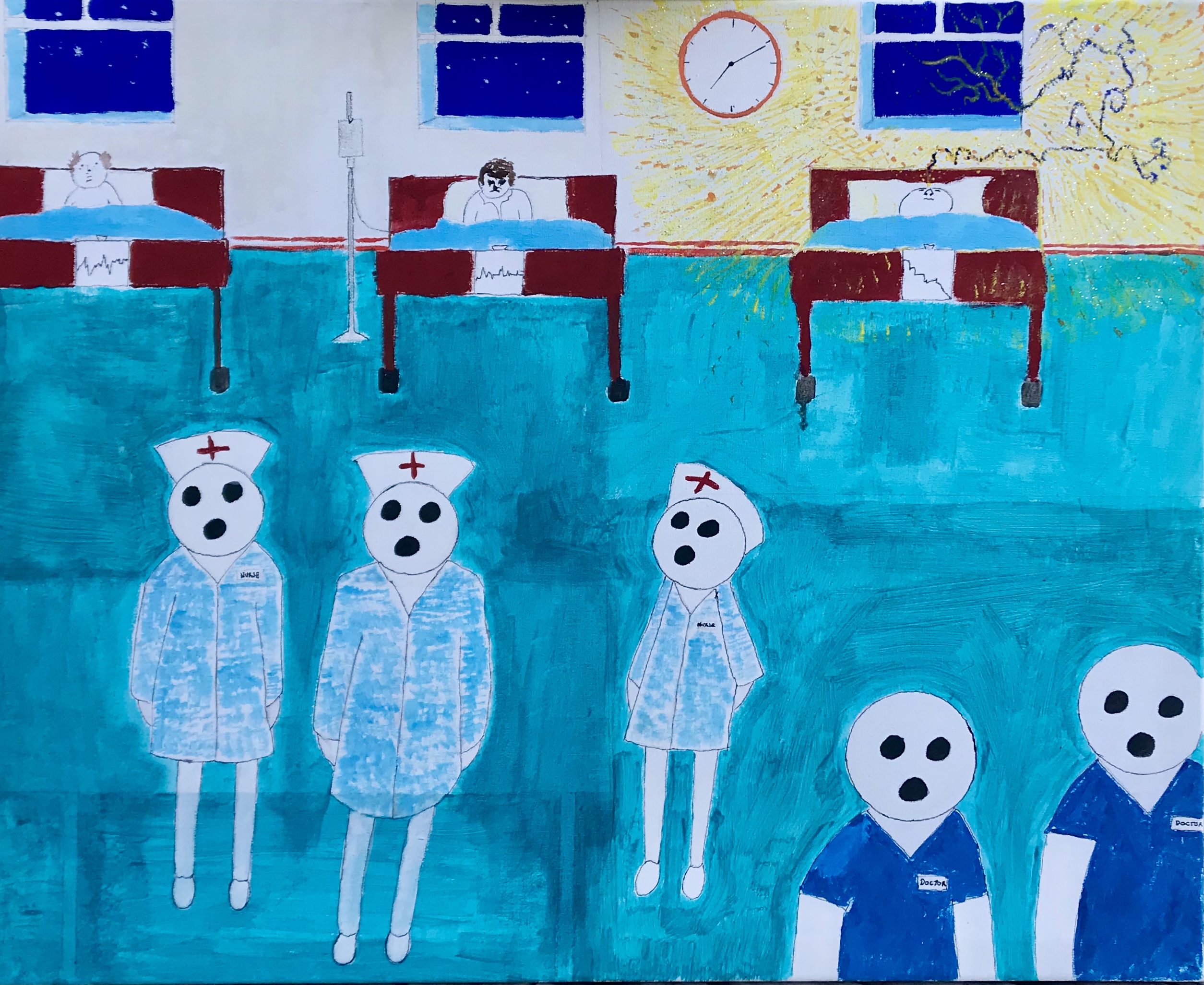
In 2022, I was fully immersed in the University of Glasgow’s End of Life Studies MSc. Programme. The module entitled Cultural Representations of Death and Dying invited me to create a unique, artistic representation of the end of life. I chose to create a painting depicting the death of my dad (See below). He died in 2014, in hospital, as the majority of people still do in the UK. I found the process of painting his death to be a deeply moving experience; an experience which formed the basis for my later MSc Dissertation exploring social death in hospitals.
End of Life Care Education
I work as an End of Life Care Clinical Nurse Specialist in a large general hospital in the South East of England. Following completion of my studies, the painting made its way to my place of work, where it generated a lot of comments and discussion. A chance encounter with the Nurse Education team earlier this year, led to the idea of integrating the medium of art into our established end of life care education programme. We ran an initial pilot study involving six members of our end of life care link nurse group and invited them to create pictorial representations of their personal experiences of end of life care either in the hospital setting or drawing from their own personal experience outside of the workplace.
We didn’t know how the session would go or what response we would provoke. The session lasted around 90 minutes, where the link nurses were left alone with artistic materials, calm music, together with their own thoughts and creativity. On returning to the group later we found them engaged, energised, and talking enthusiastically about end of life care and sharing their experiences. Each member of the group was invited to present their work and to talk about its inspiration and meaning. We encountered some very moving stories and experiences during that session. The pilot project was more successful in engaging staff than we had originally hoped, with very positive feedback throughout. The Art of Dying Project was born!
Following on from this, we started rolling this out across the hospital as part of our end of life care education programme. Starting small, on two wards at a time, staff were invited to attend Art of Dying events. Each session lasts approximately three hours in total. We start with an introduction, including a showing of my original painting and short discussion with the group. We set the scene of what the Art of Dying project is about, providing art materials, soft music and time alone as a group. The participants spend about an hour and a half creating their artwork and we (the facilitators) then return and invite staff to talk about their paintings or drawings. There’s no obligation to do so, only if people are comfortable with that. To round off the session, myself and my CNS colleague Carla Brooke (also an End of Life Studies MSc graduate!), provide about an hour of semi-structured end of life care teaching, including open discussion, with the aim of linking the Art of Dying project with hands on, end of life care on the hospital wards. Through this we hope to connect staff on a more personal and emotional level with the act of caring for a dying person in the hospital setting.
To date, approximately 40 members of staff have engaged with the Art of Dying project and we aim to roll this out across all hospital wards, starting afresh in 2026. The project is initially open to nursing staff and clinical support workers; however we intend to engage with doctors and allied health professional staff groups too. This project runs alongside our established end of life care education programme but we’re finding that the engagement from staff is on a much more personal and emotional level, a deeper level, than the standard, PowerPoint heavy end of life care teaching. So we’ve really touched on a valuable medium for engaging staff in discussions around what is often a very difficult topic to engage with.
It’s also interesting because many of our staff are overseas nurses and come from countries where end of life care is not as integrated into the general healthcare systems as in the UK. This was something that we also explored in our End of Life Studies MSc. programme. Listening to the experiences of staff from overseas about their perceptions of end of life care both in their own countries and in the UK has been one important aspect of the Project so far. The Art of Dying Project is in its infancy, yet so far is proving to be a novel and engaging way of teaching staff how to care for dying people, their family and friends in the challenging environment of the hospital ward. This project is a direct result of my studies at the University of Glasgow, and I owe everything to the End of Life Studies MSc. programme. It has enabled me to approach my own clinical practice in a very different way and has opened a door for engaging with hospital staff who otherwise may not have had that opportunity. Thank you.
__________________________________________________________________
The course Cultural Representations of Death and Dying can be taken as a stand alone course for CPD, or as part of the PGCert/PGDip/MSc in End of Life Studies. It runs April-July and is fully online.

Thanks so much for this. A fabulous project with great results, and longevity. I intend to share the post with the team at an independent arts organisation in Dumfries and Galloway, Cample Line, where I’m a member of the board.