

This blog post was written by Silvia Jimenez Cruz, an End of Life Studies MSc student.
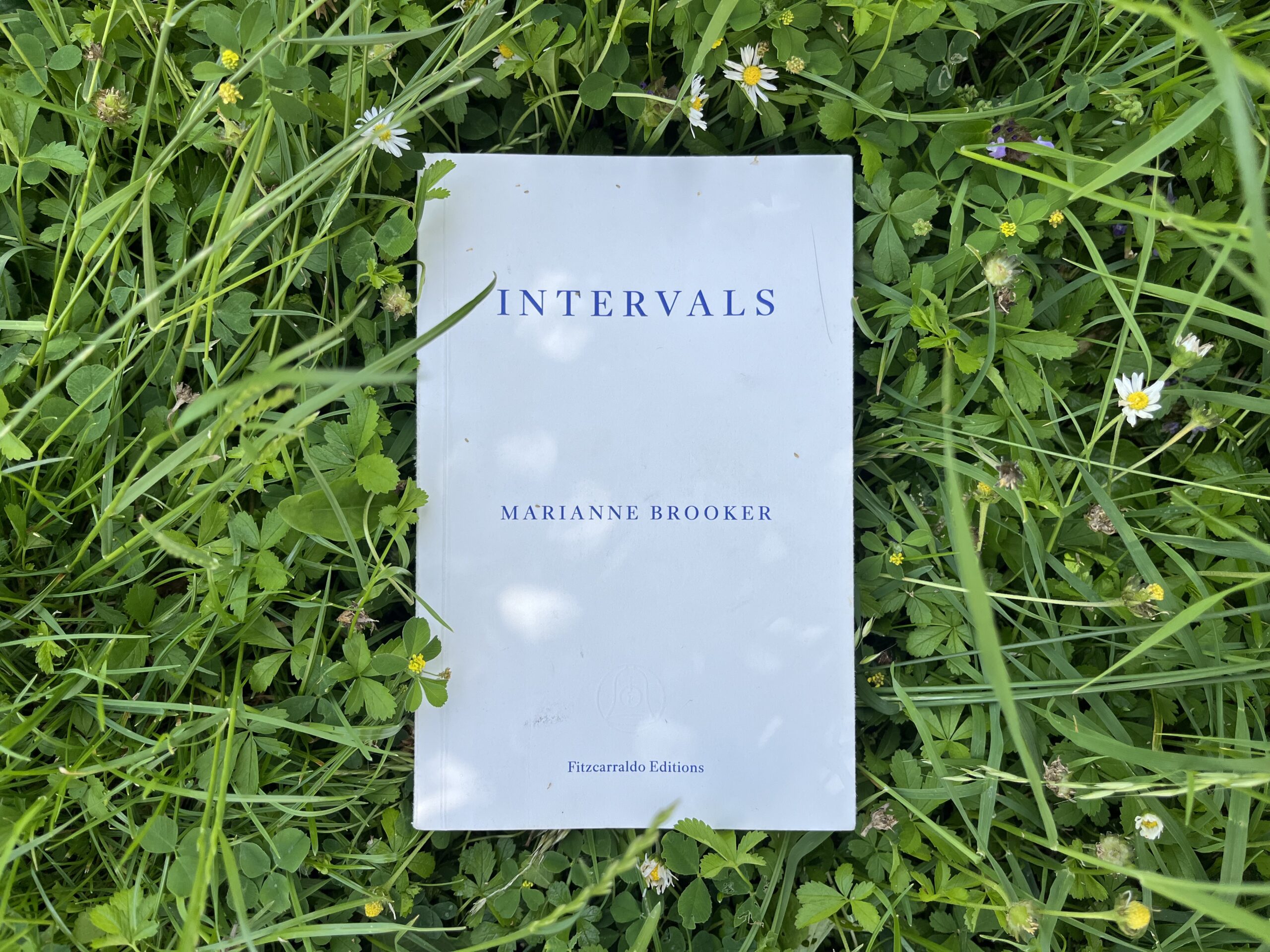
When I first read Intervals by Marianne Brooker, my knowledge of end-of-life issues was very limited, although my curiosity was ever-expanding. It was during these days that I was considering my decision to embark on the End of Life Studies MSc at the University of Glasgow. I opened the book on the 24th of November 2024, coincidentally, the same day of the UK Parliament’s Second Reading of the Terminally Ill Adults (End of Life) Bill which was passed by 330 to 275. I read this memoir again after completing my first course on the degree – Assisted Dying: Rhetoric & Reality – and I suggested it for the End of Life Studies Book Club, which meets twice a year and is open to students, lecturers and alumni of the programme.
Intervals was suggested to me by my friends at East Bristol Books, an independent bookshop in Bristol, UK, specialising in poetry, translation and small press editions. I was instantly hooked on their suggestion. The book was in their “local authors” section, and Brooker’s mother, whose death is the focus of the memoir, had a similar diagnosis (multiple sclerosis) to my own father, although my father’s disease progression has been slower and gentler on him. Reading the book was also the first time I had heard of voluntarily stopping eating and drinking (VSED) as an alternative to hastening someone’s death.
About the book
Intervals explores the politics and limitations of choice, care and creativity through the author’s experience of caring for her mother in late 2018 – early 2019 as she decides to voluntarily stop eating and drinking (VSED) to hasten her death, ten years after her diagnosis of primary progressive multiple sclerosis. Brooker skilfully describes the last weeks of her mother’s life, capturing a slowing of time alongside an urgency of being present, whilst also giving readers a window into her stance on the assisted dying debate. In Intervals, Brooker argues that it was not solely her mother’s health diagnosis and deterioration that led her to decide to hasten her own death by VSED, but a lack of support from the state.
Intervals can be classified as an essay as well as a memoir. In an interview for the podcast ‘Rippling Pages: Interviews with Writers’, hosted by Liam Bishop, Brooker recognises that the book has elements of, and blurred boundaries with, journalism, philosophy, poetry, and polemic, among other genres. The author also shares how the book came to be, first as an essay, for which she won the 2022 Fitzcarraldo Essay Prize, and then an extended period of writing whilst campaigning for the legal right to assisted dying. Whilst writing in this context, she came to the realisation she needed to pin her thoughts to her mother’s experience and her loss. In an interview for the Women’s Prize for Non-Fiction (2024) Brooker said:
“I already knew, beginning the book, that I think through writing, but it came as a revelation to me that I could feel through it, too.”
Book club discussion
We started our discussion by highlighting the different genres and references in the book. Brooker draws from poetry, essays, novels, other non-fiction and academic literature, even referencing our lecturer Dr Naomi Richards’ research.
Brooker begins her memoir by quoting a passage from The Velveteen Rabbit. This children’s story is about a stuffed toy that becomes “real” through the love of its owner. As a group, we found that this set the tone for an intimate read. Although we did not reach a consensus on the meaning of using this children’s story, my interpretation is that through the craft of writing the book and lovingly memorialising her mother’s experience, her mother’s death becomes “real” within a political context, beyond her personal experience of loss.
Although the book focuses on the ‘interval’ between her mother’s decision to stop eating and drinking and her subsequent death 3 weeks later, the book reflects personally and politically on issues such as choice, autonomy, inequality and disability, within the political debate around assisted dying.
We discussed as a group the tensions Brooker describes between VSED as a death that requires extreme autonomy, both to make the decision as well as to carry it through, and the impact of the social and economic constraints her mother experienced because of her diagnosis, which makes up the main argument of the book. The extraordinary nature of this death was also a topic of discussion, as it is not widely represented in memoirs or in the media. Other examples of memoirs where a person opts for VSED to hasten their death are Choosing to Die: A Personal Story by Phyllis Sachter (2017) and One Last Thing: Conversations on Life, Death and Assisted Dying by Wendy Mitchell with Anna Wharton (2023), for those looking to explore these issues further.
Towards the end of the book, we were collectively taken aback by the revelation of another character – Brooker’s sister – who had not previously been mentioned.
“There’s one person who has asked to be kept from these pages. Her time in this story has been served and it’s not for me to summon her back against her will.” (2024, p.137)
Brooker reveals very little about her sister’s involvement and participation in caring for her mother during the days of ’the interval’, beyond this paragraph. She also seldom mentions anyone outside the hospice team, whom she thanks on every possible occasion. The author also does not quote or paraphrase any dialogue. As a group, we discussed the implications of this in how we perceived the story, and the new interpretations this revelation brought for us.
Returning to Intervals after joining the MSc in End of Life Studies enriched my reading of this book. While my initial response was shaped largely by personal experience and curiosity, on my second reading I was more critically engaged with her arguments about choice, inequality and disability, and I had greater appreciation for the tensions she exposes between individual agency and structural constraints. Reading and discussing the book through the lens of the programme reinforced for me the value of memoir as a way of exploring difficult end-of-life questions, not only through policy and theory, but through lived experience.
_____________________________________________________
Silvia Jimenez Cruz, originally from Chile, lives in Bristol, UK, with her husband and two children. She currently works for a local charity managing a service aimed at improving wellbeing and social connections in later life. She is also a student in the End of Life Studies Msc programme.