

This blog is written by Gina Tarditi – a PhD candidate at the End of Life Studies Group
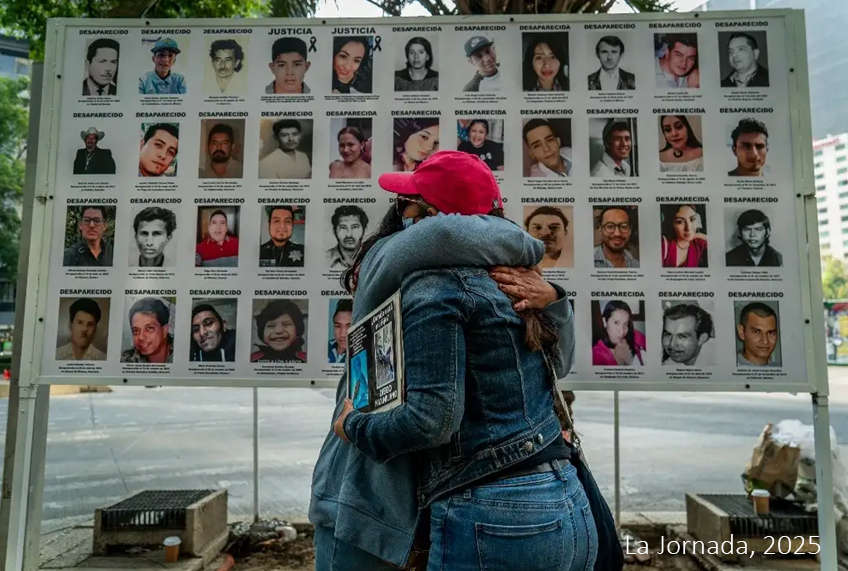
Total pain in the indirect victims of the desaparecidos was recently published in Frontiers in Sociology as part of a special issue dedicated to Cicely Saunders’ concept of ‘total pain’. The relevance of this concept within modern medicine, especially in palliative medicine, is widely acknowledged. This special issue aims to revisit the concept of total pain, imagining new territories in which to apply it, and to consider its capacity to articulate other complex forms of suffering. As part of my doctoral thesis on grief, I have identified the suffering endured by the indirect victims of disappearances in Mexico to be one of the most complex and challenging types of suffering currently affecting many thousands of families in Mexico.
The phenomenon of desaparecidos in Mexico and other Latin American countries has a long story that began during the so-called “dirty war” lasting from the 1960s through to the 1990s. In Mexico, however, the phenomenon has continued and even increased over the last two decades, taking on new forms. Today in Mexico, people disappear for reasons of slavery, trafficking, forced labour, and gender violence (Rodríguez Fuentes, 2017). About 75% of the desaparecidos are young adults, aged 15 to 40. They are students, migrants, journalists, politicians, and human rights activists.
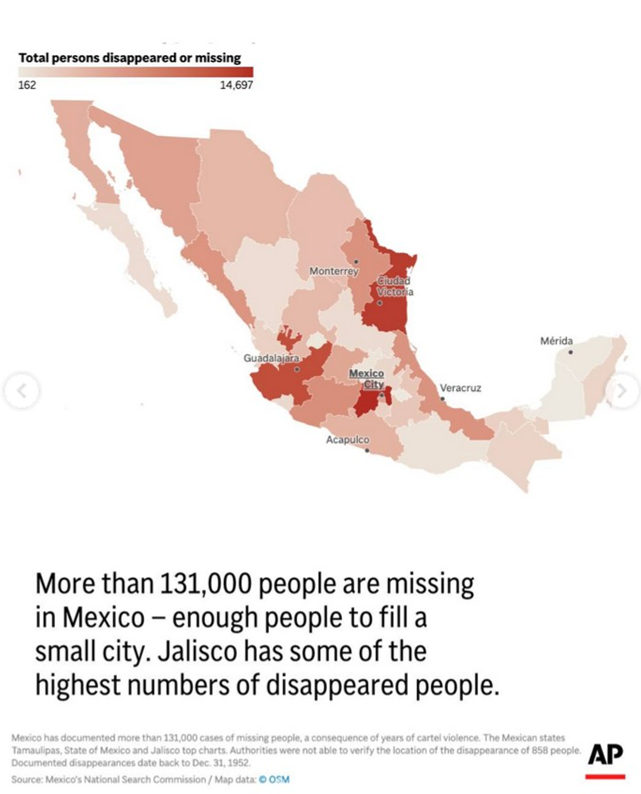
The disappearance of a person triggers multiple layers of suffering experienced by the entire family. This suffering traverses the physical, emotional, social, and spiritual realms. Families find themselves not knowing if their desaparecidos are alive or dead. The wound that this type of suffering creates has the potential to be transmitted intergenerationally (Faúndez et al., 2017). The suffering is further complicated by the legal and political issues involved. Moreover, the indirect victims endure inadequate and ineffective support protocols from the Comisión Nacional de Búsqueda (2026), which was created to assist them in navigating this experience.
The indirect victims, mainly women, have organised more than 230 searchers’ collectives. Their life mission is searching for their desaparecidos, and in this endeavour, they challenge official narratives and impunity. In doing so, they put their own safety at risk. They have documented verbal or written threats, extortions, robbery, torture, and even death (Nuño and Ayala Martínez, 2025). This phenomenon is causing damage at the micro (victims), meso (community), and macro (society) levels (Hernández-Brussolo et al., 2022).
This type of suffering has been studied and explained through various theories of grief, such as ambiguous loss (Boss, 2017) and disenfranchised grief (Doka, 1989). Pauline Boss, an American psychologist, argues that the indirect victims live with the physical absence but psychological presence of their desaparecidos. Kenneth Doka, an American psychologist and gerontologist, introduced the concept of disenfranchised grief in 1989 to refer to any loss that is not recognised or validated by the social group to which one belongs. This is the case for most indirect victims of desaparecidos, whoare often blamed for inadequate parenting, and the disappeared are frequently suspected of criminal acts. In sum, they face indifference, stigmatisation, and/or abandonment by their communities and authorities (Bourguignon et al., 2021).

While ambiguity and disenfranchisement are usually present in these experiences, I believe they cannot fully capture the nuances of the indirect victims’ embodied experience. Therefore, I propose exploring whether we could better articulate these embodied experiences by applying the concept of ‘total pain’ (Saunders, 1964). It was Cicely Saunders, an English physician, who came up with the concept of total pain in 1964, after years of experience at their bedside of terminally ill patients. She began developing the concept during the post-Second World War period, when patients were facing both the end of their lives and their personal histories of war wounds and displacement (Wood, 2024).
Total pain offers flexibility and a holistic framework that, in my opinion, can be extrapolated to the experiences of the indirect victims of desaparecidos for at least three main reasons.
- Saunders highlighted that ‘total pain’ is not a single event but a situation that begins in the body and then extends to other dimensions of life – emotional, social, and spiritual (Wood, 2022). In the case of desaparecidos, the victim’s pain does not begin in the body, but the suffering also extends and invades all human realms.
- Terminally ill patients were, and still are, abandoned by the staff supposed to care for them until the end. In the case of the indirect victims of desaparecidos, they are also often abandoned by their social networks and by the state. The explanation may be found in the incapacity and lack of skills to engage in emotional work while dealing with systemic constraints and the inherent complexity of this phenomenon.
- Saunders noted that the experience of pain was always embedded in the patient’s wider social, cultural, and historical contexts, including their lived experiences of war and displacement. Likewise, in the case of the indirect victims of disappearances, we need to understand their multidimensional suffering within their wider sociocultural, economic, historical, and political context.
Saunders showed that when caring for those suffering at the end of their lives, both knowledge and presence were central. Therefore, listening to her patients’ narratives became paramount for better understanding their experiences, communicating them to broader audiences, and, as a result, fostering structural changes to improve patient care. The question is whether we are capable of actively listening to the indirect victims’ experiences with an open mind. It is particularly important in Mexico, where silence on this matter prevails, and the facts are often denied or minimised.
The indirect victims of desaparecidos in Mexico live with ambiguity, and their suffering is frequently disenfranchised. At the same time, they live in a prolonged liminal state that affects their physical, emotional, social, and spiritual stability. I argue that ‘total pain’ provides a flexible and holistic framework for understanding their overall lived experiences, situating them within specific sociocultural, historical, and political contexts. From my perspective, this approach could facilitate an open dialogue among all key actors—indirect victims, communities, care providers, authorities, and scholars from different disciplines. Eventually, this would contribute to the development of support programs and public policies that are aligned with the inherent complexities of this type of suffering.
__________________________________________________________
Biography
Gina Tarditi is a psychologist specialising in grief. She graduated in 2023 with an MSc in End of Life Studies. In January 2025, she began her PhD in Health and Social Policy at the University of Glasgow, under the supervision of Dr. Marian Krawczyk and Professor Naomi Richards.
__________________________________________________________
References
- Rodríguez Fuentes, O. D. (2017). Historia de la Desaparición en México: Perfiles, Modus y Motivaciones. Derecho y Ciencias Sociales. 17, 247–271. doi: 10.24215/18522971e018
- Faúndez, X., Azcárraga, B., Benavente, C., and Cárdenas, M. (2017). La desaparición forzada de personas a cuarenta años del Golpe de Estado en Chile: un acercamiento a la dimensión familiar. Revista Colombiana De Psicología 27, 85–103. doi: 10.15446/rcp.v27n1.63908
- Comisión Nacional de Búsqueda. (2026). Gobierno de México. Available online at: https://comisionacionaldebusqueda.segob.gob.mx/cnb/ (Accessed February 10, 2026).
- Nuño, A. and, Ayala Martínez, A. (2025). 27 Personas Buscadoras han sido Asesinadas y tres más Desaparecidas en México. Available online at: https://adondevanlosdesaparecidos.org/2025/04/04/27-personas-buscadoras-han-sido-asesinadas-y-una-mas-desaparecida-en-mexico (Accessed December 5, 2025).
- Hernández-Brussolo, R., Quiñones Soto, J., and Limas Hernández, A. (2022). Repercusiones Psicológicas en Víctimas Secundarias de Desaparición: Una Revisión Sistemática. Revista Guillermo de Ockham. 20, 191–203. doi:10.21500/22563202.5623
- Boss, P. (2017). Families of the missing: psychosocial effects and therapeutic approaches. Int. Rev. Red Cross 99, 519–534. doi: 10.1017/S1816383118000140
- Doka, K. J. (1989). Disenfranchised Grief: Recognizing Hidden Sorrow. Lexington: Lexington Books.
- Bourguignon, M., Dermitzel, A., and Katz, M. (2021). Grief among relatives of disappeared persons in the context of state violence: an impossible process? Torture 31, 14–33. doi: 10.7146/torture.v3li2.127344
- Saunders, C. (1964). The Care of the Terminal Stages of Cancer. Annals of the Royal College of Surgeons of England 41, Supl, 162–169.
- Wood, J. (2024). Cicely Saunders and the literary and cultural heritage of “Total pain”. Lit.Med. 42, 65–87. doi: 10.1353/lm.2024.a935834
- Wood, J. (2022). Cicely Saunders, ‘Total pain’ and emotional evidence at the end of life. Med. Humanit. 48, 411–420. doi: 10.1136/medhum-2020-012107